
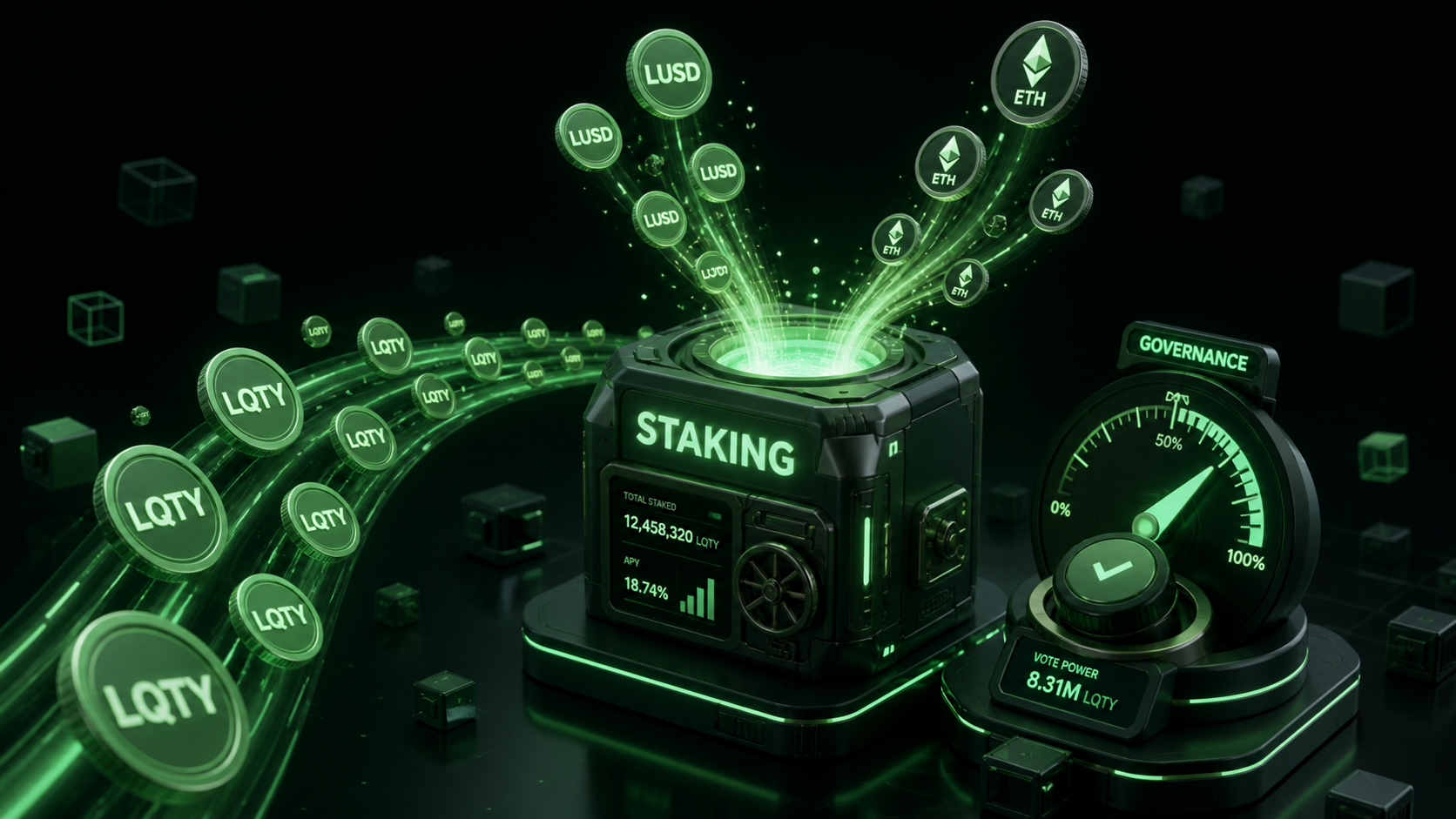
Staking LQTY takes about two minutes and pays from two separate sources: LUSD and ETH fees from Liquity V1, and weekly voting power over 25% of all interest revenue collected by Liquity V2. There is no lockup, no minimum, and no slashing. The only cost of unstaking is the voting power you have accumulated, which resets to zero the moment you withdraw.
That last detail is what makes LQTY staking different from most yield positions. The longer a stake sits untouched, the more influence it carries, so the position rewards patience in a way that has nothing to do with the size of the deposit.
What Staking LQTY Actually Pays
Two streams arrive from two different protocols, and they behave nothing alike.
Liquity V1 pays stakers directly. Every LUSD borrowed or redeemed on the original protocol charges a one-off fee, and those fees are distributed to staked LQTY in LUSD and ETH. It is real revenue in liquid assets, it requires no action beyond staking, and it arrives irregularly because it depends on new V1 loan activity rather than on outstanding debt.
Liquity V2 pays stakers nothing directly. Instead, 25% of the interest V2 borrowers pay flows into Protocol Incentivized Liquidity, a weekly budget that stakers vote to allocate to on-chain addresses. Stakers direct that money rather than receiving it, and the compensation for doing so comes from projects competing for the votes. Understanding the differences between Liquity V1 and V2 makes the split easier to reason about, because the two protocols were designed under opposite assumptions about how a token should capture value.
Staking LQTY Step by Step
Liquity AG operates no frontend, so staking happens through an independent interface. Liquity.App, DeFi Saver, LQTY.IO, and Trove Zero all support it.
- Fund an Ethereum wallet with LQTY and enough ETH for gas. If you bought the token on an exchange, withdraw it to a wallet you control first, and confirm you have the private keys to that wallet.
- Open one of the V2 frontends and connect the wallet. The staking interface sits under the Stake section.
- Approve the LQTY token contract for the amount you intend to stake. This is a standard ERC-20 approval and costs one transaction.
- Submit the stake. The first time an address stakes, the protocol deploys a small proxy contract to hold the position, so some wallets display a new-contract warning. That is expected behaviour.
- Allocate your votes. A stake earns V1 fees regardless, but voting power sits idle until you assign it to initiatives.
Withdrawing works the same way in reverse and can be done at any moment. Accrued LUSD and ETH rewards are claimed separately from the stake itself.
How Voting Power Accrues
Voting power is calculated as staked LQTY multiplied by staking age, growing linearly for as long as the position is left alone. Two people staking identical amounts a year apart hold very different influence, and the earlier staker keeps that advantage indefinitely.
Three consequences follow from that formula:
- Adding to an existing stake starts the new tokens at zero voting power. Total power does not jump, though it begins growing faster. This is what makes flash-loan vote capture impossible.
- Unstaking causes an immediate drop in voting power proportional to what you removed, and the accumulated age on the withdrawn portion is gone permanently.
- Relative power matters more than absolute power, since your share is your voting power divided by everyone else's. A stake that sits still while others churn gains ground without any action.
The effect is a soft commitment device built on top of a token with a fixed 100 million supply and no emissions. Nothing contractually locks the tokens, and the incentive structure still concentrates influence among holders who have been there longest.
Voting on Initiatives Each Week
Epochs run weekly, starting with the first Ethereum block after 00:00 UTC on Thursday and ending at 23:59:59 UTC the following Wednesday. Within that window:
Stakers split their voting power across any combination of registered initiatives, which are typically liquidity pools, lending market integrations, or other venues that improve BOLD liquidity. Votes carry over automatically to the next epoch, so a staker who sets an allocation once does not need to return every week.
Both upvotes and downvotes are available, though in the final 24 hours of an epoch only downvotes can be cast, which gives the community a late window to veto an initiative that turns out to be problematic. An initiative needs at least 2% of total votes to receive anything, and incentives must be claimed within the same week or they roll into the next round.
Registering a new initiative requires 0.01% of total voting power and a 100 BOLD fee, according to Liquity's documentation. Projects that want the budget have started paying stakers for their votes, which recreates the vote-buying market that made Convex a force in the Curve wars, on a smaller scale and without a locking contract.
Frequently Asked Questions
How much can you earn staking LQTY?
Returns come from Liquity V1 fee revenue in LUSD and ETH, which varies with V1 borrowing and redemption activity, plus any payments received for directing Protocol Incentivized Liquidity votes. Liquity publishes no fixed APR because neither stream is guaranteed, and V2 annualized PIL revenue sat around $445,000 as of August 2026. Yield on a small stake is modest, and the governance influence is often the larger reason to hold.
Is there a lockup period for staking LQTY?
No. LQTY can be unstaked at any time with a single transaction. The only penalty is the loss of accumulated voting power, which resets to zero on the withdrawn amount and cannot be restored by restaking. Liquity's PIL design uses that time-weighting instead of a contractual lock.
Can you stake LQTY on an exchange?
Liquity staking happens on-chain through the protocol's own contracts, so it requires a self-custody wallet and an independent frontend. Exchanges list LQTY for trading rather than staking. Traders who want exposure without running a position on Ethereum typically hold or trade the token instead.
Staking as a Long Game
LQTY staking suits holders who intend to keep the position for months rather than weeks. The V1 fee stream pays regardless of how long you have been there, but the part of the design that actually matters, control over the weekly incentive budget, compounds with time and vanishes the moment you exit. That asymmetry is deliberate.
Whether that influence is worth accumulating depends on how large the PIL budget becomes, which is the same variable behind LQTY's price outlook. A bigger BOLD debt book makes every vote worth more, and today's budget is small enough that early stakers are effectively buying cheap influence over a market that may not exist at scale for years.
Need LQTY to stake, or a way to hedge the position? LeveX lists LQTY spot pairs and LQTY perpetual futures, and Crypto in a Minute covers staking mechanics across other protocols.