
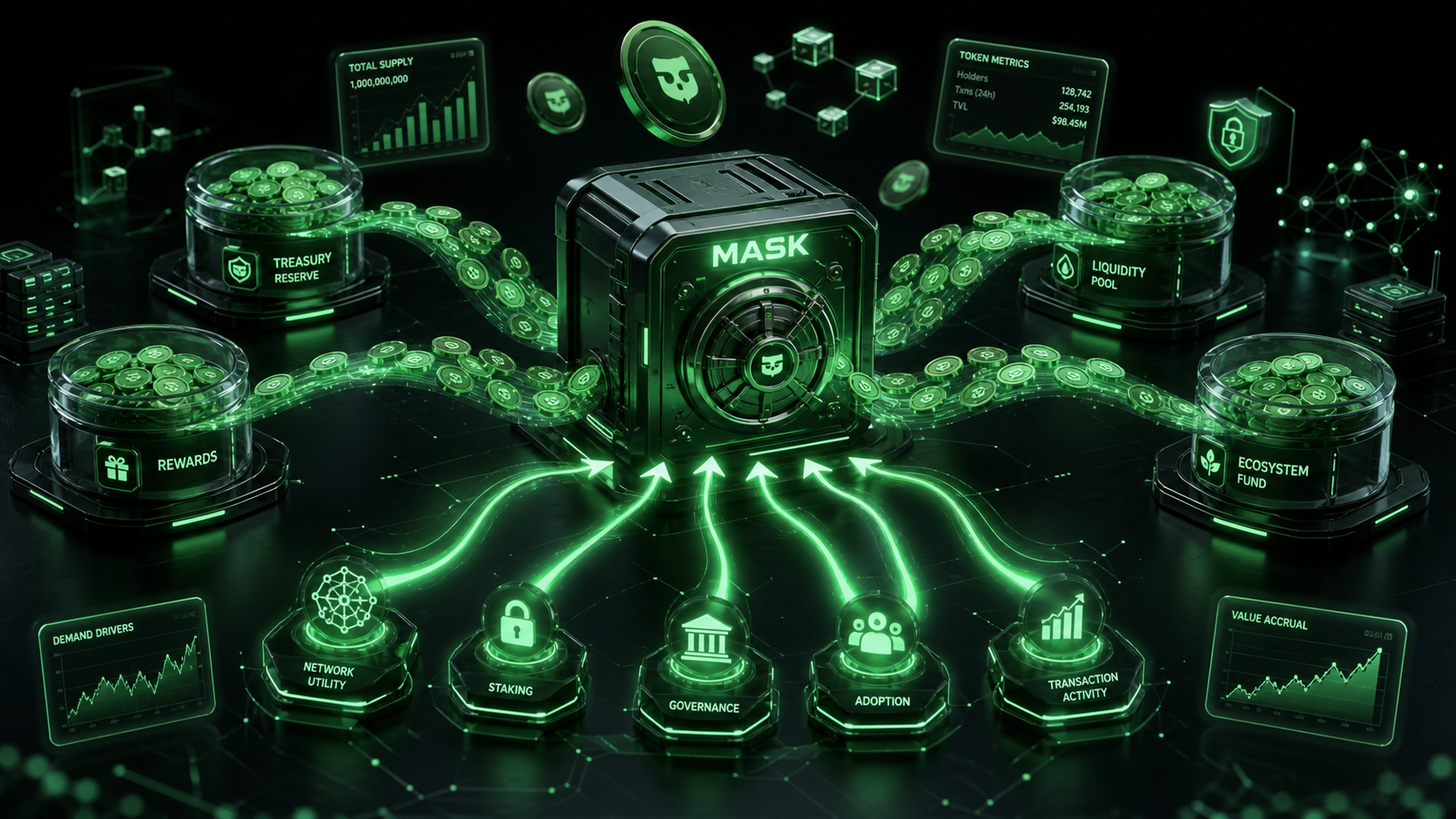
One hundred million MASK were created at genesis in February 2021, no contract function can create more, and every unit has been circulating since early 2024. That makes Mask Network one of the rare mid-life crypto assets with nothing left to unlock, so its market capitalization and fully diluted valuation are the same number.
What the token does with that supply is narrower than the headline "governance token" label suggests. MASK carries voting weight in MaskDAO, gates a handful of advanced product features, and periodically gets paid out as a reward. It does not receive protocol fees, and no burn mechanism reduces the float.
The Genesis Allocation
The initial distribution leaned heavily toward the foundation and the team, with investors across five priced rounds and only 8% reaching the public directly.
| Category | Share | Purpose |
|---|---|---|
| Foundation Reserve | 39.55% | Ecosystem grants, development, DAO treasury |
| Team | 23.00% | Contributors and operations |
| Angel Round | 8.00% | Earliest backers |
| Public Offering | 7.00% | Initial Twitter Offering and bootstrapping pool |
| Seed Round | 6.25% | Early investors |
| Private Round B | 5.74% | Later private investors |
| Private Round C | 5.61% | Later private investors |
| Private Round A | 2.85% | Later private investors |
| Liquidity Pool | 1.00% | Market making |
| Airdrop | 1.00% | Early extension users |
Insider allocations totalled just over 62% between the foundation and the team, with a further 28.45% across the four private rounds and the angel tranche. Investor names attached to those rounds include Animoca Brands, DWF Labs, and the fund formerly known as Binance Labs, alongside Alameda Research, whose position was liquidated during the 2022 collapse. Locked allocations followed a schedule that completed around month 36, which is why the float stopped growing in early 2024.
How the Initial Twitter Offering Worked
Mask launched its token through its own product, which remains the most interesting thing about the distribution. The ITO plugin let anyone with the browser extension buy directly inside a tweet, and the team used it on themselves in February 2021.
The public 7% split into two mechanisms. Roughly 3% of supply sold at a fixed price through rounds capped at 2,000 MASK per address, a deliberate anti-whale constraint that produced thousands of small holders instead of a handful of large ones. The remaining 4% went through a Balancer liquidity bootstrapping pool, where the starting price is set high and decays until buyers meet it, which suppresses front-running by bots. The project's own launch post describes the design and the 3 million tokens routed to ITO participants.
Price discovery afterwards was violent. MASK printed an all-time high of $41.45 on 24 February 2021, days after launch, on a float that represented a small slice of eventual supply. Every valuation discussion since has been anchored to a number set when 90% of the tokens did not yet exist in the market.
Where MASK Demand Comes From
Governance Weight
Each MASK equals one vote in MaskDAO, and votes require the tokens to have been locked in governance for the seven days preceding a proposal. That lock is the closest thing MASK has to a supply sink, since it temporarily removes voting balances from circulation, though the volumes involved are small relative to the float.
Feature Gating
Certain advanced extension functions, including cross-chain wallet features and enhanced social profiles, require holding MASK. This creates real utility demand tied to active users rather than speculation, and it is also the demand channel most sensitive to whether the products attract users at all.
Reward Programs
MaskDAO has run staking and reward seasons that distribute MASK to participants who use the ecosystem or provide liquidity. These programs recycle treasury tokens into the hands of users, which supports engagement while adding sell-side supply from recipients who take the reward and leave.
Missing from that list is the mechanism most token models rely on. MASK has no fee share, no revenue split, and no buyback. The token is a claim on decisions rather than on cash flows, a structure that has become less fashionable as the market has grown more insistent about value accrual.
What Full Circulation Means for Traders
An unlock-free supply removes the most common source of scheduled downside in small-cap crypto. There is no cliff to trade around, no quarterly vesting event that reliably pressures price, and no team allocation about to enter the market. Compare that with tokens still working through multi-year distributions, where Aptos token unlocks remain a standing feature of the chart, and MASK's supply profile looks unusually clean.
The mirror image is that supply mechanics offer no help either. Price moves only when demand moves, and with roughly $5 million in daily volume against a $35 million market cap as reported by CoinGecko in August 2026, modest flows move the price a long way in both directions. The MASK price outlook therefore reduces to a single question about adoption, with no supply-side story to complicate or cushion it.
One practical detail matters for holders. MASK originates as an ERC-20 on Ethereum at contract 0x69af...3074, with bridged deployments on BNB Smart Chain, Polygon, and Energi. Those bridged versions are separate contracts, so liquidity is fragmented across chains and the canonical Ethereum token is the reference for supply figures.
Frequently Asked Questions
How many MASK tokens are in circulation?
All 100 million MASK are in circulation as of August 2026. Total supply, maximum supply, and circulating supply are identical, and the ratio of market cap to fully diluted valuation is 1.0. No further tokens can be minted.
Does MASK have a burn mechanism?
No. MASK has no burn, no fee-based buyback, and no deflationary schedule. The supply set at genesis in 2021 is the supply that exists permanently, so the token is neither inflationary nor deflationary.
What gives MASK its value?
MASK derives value from governance rights over MaskDAO, which oversees the Mask ecosystem and its stewardship of the Lens social graph, plus access to gated features inside the Mask Network extension. It does not receive protocol revenue, so its price reflects expectations about ecosystem adoption and governance influence.
Who holds the largest share of MASK?
The genesis allocation gave 39.55% to the Foundation Reserve and 23% to the team, so treasury and insider-linked addresses have historically held the largest balances. Public block explorers show current distribution, and concentration remains a governance consideration given that voting power scales directly with holdings.
Reading MASK's Supply as a Trader
MASK's tokenomics are simple in a way that removes excuses. There is no dilution to blame for weak price action and no unlock to wait out before a thesis can work, which leaves adoption of the extension, Firefly, and the Lens ecosystem as the entire case for the token. That clarity cuts both ways, since a fixed supply does nothing for a token nobody needs to hold.
The governance-only structure is the piece most likely to change. Product-side monetization exists across the ecosystem, and any future proposal that routes even a fraction of it toward MASK holders would alter the token's economics more than any supply metric could. Until such a proposal passes, holders own votes and optionality.
Pick up MASK on spot or trade the volatility with MASK perpetual contracts on LeveX. Our Crypto in a Minute library covers tokenomics for dozens of other assets.